Lab 3: Kirchoff's Current and Voltage Laws
Archie Wheeler
Michael McMearty
01.30.2012
A pdf version of this lab may downloaded here.
The odt version of this lab may be downloaded here.
Abstract
Within this lab, we studied Ohm's law on simple circuits and verified the rules that we use to combine resistors. In parts 5 and 6, we created several complex circuits, and used Kirchhoff's laws to determine the currents through different arms of the circuit. The lab turned out to be an epic success, and there was much merriment.
Contents
Objectives
- To study the relationship between current and voltage in DC circuits.
- To observe resistance, current, and voltage relationships in series and parallel combinations.
Methods
Part 1: Resistance in series:
We will connect three resistors with values of about 2200Ω, 3300Ω, and 4700Ω in series as shown in figure 3. We will record a table of nominal and measured resistance values, and calculate the percent deviation. This table will include rows for R1, R2, R3, R1+R2, R2+R3, and R1+R2+R3.
Part 2: Voltage for resistors in series:
We will plug the banana leads of two breadboard leads into the positive and negative receptacles on the power supply. The wires will then be put into a breadboard across the three resistors in series with an ammeter shown in figure 3. The voltage will be set to about 15 volts. The voltage will be measured and recorded for R1, R2, R3, R1+R2, R2+R3, and R1+R2+R3. These resistances will be compared to the products of the current and the corresponding resistance values to obtain percentage errors.
Part 3: Resistance in parallel:
Three resistors will be connected in parallel. We will measure the resistance of the three resistances in parallel and compare it to 1/Req=1/R1+1/R2+1/R3.
Part 4: Current for resistors in parallel:
We will connect a power supply to the parallel combination of the three resistors. The voltage will be set to 15 volts, and the meters will be set to measure the resistance, and I1, I2, and I3. A table will be kept with resistance, voltage, and current. We will compare V/R to I for each of the rows in the table.
Part 5: Complex Circuit:
We will setup the following circuit and compare the calculated and measured equivalent resistance of the resistor network.
![[circuit schematic]](part5-schematic.png "Circuit Schematic")
Circuit schematic
We will then connect the battery to the resistor network and measure the voltage drop and current through each resistor. In a table, the measured and calculated values will be compared, and a column for the power dissipated by each resistor will be kept.
Part 6: Kirchoff's Law Circuit
Using 3 resistors with values of 2200Ω, 3300Ω, and 4700Ω, the circuit in figure 5 will be built. The values of V1, V2, I1, I2, and I3 will be recorded, and compared with theoretical values found by Ohm's Law and Kirchoff's Laws. The values of I1, I2, and I3 are determined theoretically from the three equations:

The first equation is the current law, the second is the voltage law applied to the left side of the loop and the third is the voltage law applied to the right side of the loop. By solving these equations, one can arrive at theoretical values for the data.
Setup
Materials:
- 2 Digital multimeters
- 2 DC power couples, 0-15V
- Assorted Resistors
- Circuit boards, circuit board leads
- Graphical Analysis and mathcad software
![[setup for parts 1 and 2]](figure3.jpg "Setup for parts 1 and 2")
Setup for parts 1 and 2
![[setup for parts 3 and 4]](figure4.jpg "Setup for parts 3 and 4")
Setup for parts 3 and 4
![[setup for part 6]](figure5.jpg "Setup for part 6")
Schematic for part 6
![[setup for part 6]](figure6.jpg "Setup for part 6")
Setup for part 6
Data and Analysis
Part 1
Data and analysis for part 1| Resistance(Ohms) | Voltage(V) | Current(mA) | Experimental Resistance (Ohms) | Percent Error | |
|---|---|---|---|---|---|
| R1 | 2200 | 4.94 | 2.14 | 2308 | 4.93% |
| R2 | 3300 | 4.95 | 1.49 | 3322 | 0.67% |
| R3 | 4700 | 4.87 | 0.977 | 4985 | 6.06% |
| R1+R2 | 5500 | 4.89 | 0.868 | 5634 | 2.43% |
| R2+R3 | 8000 | 4.96 | 0.591 | 8393 | 4.91% |
| R1+R2+R3 | 10200 | 4.93 | 0.464 | 10625 | 4.17% |
Part 2
Data and analysis for part 2| Resistance(Ohms) | Battery Voltage (V) | Current(mA) | Theoretical Voltage Drop(V) | Experimental Resistance (Ohms) | Percent Error | |
|---|---|---|---|---|---|---|
| R1 | 2200 | 15 | 1.41 | 3.10 | 3.25 | 4.77% |
| R2 | 3300 | 15 | 1.41 | 4.65 | 4.69 | 0.80% |
| R3 | 4700 | 15 | 1.41 | 6.63 | 7.03 | 6.08% |
| R1+R2 | 5500 | 15 | 1.411 | 7.76 | 7.94 | 2.31% |
| R2+R3 | 8000 | 15 | 1.411 | 11.29 | 11.73 | 3.92% |
| R1+R2+R3 | 10200 | 15 | 1.412 | 14.40 | 14.99 | 4.08% |
Part 3
By using the following equation, we can determine the theoretical equivalent resistance of three resistors in parallel.
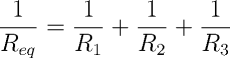
If R1=2200Ω, R2=3300Ω, and R3=4700, any modern scientific calculator with a competent user will arrive at a R_eq value of R_eq=1031Ω.
Data and analysis for part 3| Voltage | Current | Experimental Resistance(Ohms) | Theoretical Resistance(Ohms) | Percent Error |
|---|---|---|---|---|
| 14.99 | 14.03 | 1068 | 1031 | 3.67% |
Part 4
Data and analysis for part 4| Resistor | Resistance(Ohms) | Voltage(V) | Power Experimental(mW) | Current(mA) | Theoretical Current(mA) | Percent Error |
|---|---|---|---|---|---|---|
| R1 | 2200 | 14.98 | 98 | 6.53 | 6.81 | 4.10% |
| R2 | 3300 | 14.98 | 68 | 4.54 | 4.54 | 0.01% |
| R3 | 4700 | 14.98 | 45 | 3.02 | 3.19 | 5.25% |
| Total | 1031 | 14.98 | 210 | 14.02 | 14.54 | 3.55% |
Part 5
Circuit schematic
![[Photo of our setup]](part5-picture.jpg "Our setup for part 5")
Photo of our setup
| Resistor(Ohms) | Voltage Drop(V) | Current(mA) | Experimental Resistance(Ohms) | Theoretical Resistance(Ohms) | Percent Error |
|---|---|---|---|---|---|
| R1(1500) | 4.72 | 3.15 | 1498 | 1500 | 0.11% |
| R2(2200) | 4.72 | 2.04 | 2314 | 2200 | 5.17% |
| R3(4700) | 10.39 | 2.08 | 4995 | 4700 | 6.28% |
| R4(3300) | 10.39 | 3.12 | 3330 | 3300 | 0.91% |
| R1+R2 | 4.72 | 5.19 | 909 | 892 | 1.97% |
| R3+R4 | 10.39 | 5.19 | 2002 | 1939 | 3.26% |
| R1+R2+R3+R4 | 15.13 | 5.19 | 2915 | 2831 | 2.99% |
Part 6
![[Photo of our setup]](part6-picture.jpg "Our setup for part 6")
Photo of our setup
Schematic diagram
V1=5.00V
V2=10.00V
R1=2220Ω
R2=3300Ω
R3=4700Ω
Rather than dealing with all the algebra, we decided to solve this with a matrix, so here it is.
![[initial matrix]](initial-matrix.gif "Initial Matrix")
Which reduces to
![[final matrix]](final-matrix.gif "Final Matrix")
| Theoretical(mA) | Experimental(mA) | Percent Error | |
|---|---|---|---|
| Current 1 | -2.91 | -2.78 | 4.47% |
| Current 2 | 1.09 | 1.06 | 2.75% |
| Current 3 | 1.83 | 1.71 | 6.56% |
Conclusion
The lab was a success. Ohm's laws, the rules for combining resistors in series and parallel, and Kirchhoff's rules for voltage and current were all supported very well by our data. Oh, of only the great Gustav Kirchhoff and Georg Ohm were here with us in the laboratory for this most exciting experiment. The beauty of our circuits, and the accuracy of our experiments would no doubt bring a tear of joy to their eyes.
As mind-bogglingly amazing and accurate and wonderful this lab was, there was still some error in this lab. Possible sources include the destructive and wicked forces of internal resistance. These wonderful wires that our fearless TA's provided us were certainly very willing to transmit current without much resistance, but sadly, even these wires had some resistance. Not 100% of the resistance in our setup was in the resistors, and our equations did not account for this. It is also unfortunate (at least in the context of the accuracy of this experiment) that resistance increases with an increase in temperature. As current was running through our setup, the resistors warmed up, and their resistances increased. This means that as we were measuring the current through other resistors, the current was changing as the resistance was changing in the other parts of the circuit.
It was a delight to perform this glorious experiment. I was overcome by the beauty of it all every time I plugged a lead into the breadboard. The lab, as it exists, is very thorough and illustrates electrical principles very nicely. But in order to illustrate these principles even more nicely, it might be good to hook up six multimeters simultaneously to the circuit, so one could take in all the data (and beauty) simultaneously. Other than that though, I believe the lab was very free of errors.
Signature

Archie Wheeler
01.31.12