{short description of image}

EDAL 520 - FOUNDATIONS OF EDUCATIONAL LEADERSHIP

Fall, 2005

To Educate is to Redeem
 Instructor
*Dr. Gary Gifford, BH 173, (269) 471-6682, e-mail: ggifford@andrews.edu
Classroom: BH 180, W 6:30p.m.-9:20p.m
Course Webpage: http://www.andrews.edu/~ggifford/Copy of EDAL520SU05


I. COURSE DESCRIPTION

This course is intended to provide an overview of educational administration and leadership drawing from theory, research, and practice. According to the 2005-2006 Andrews University bulletin, this course will address the purposes, organization, and administration of educational programs and institutions; the structure and control of school systems; the nature of administration; conceptual foundations of educational administration.

top of page


II. COURSE OBJECTIVES

This course serves as the introductory course for degrees and certification in educational administration. The purpose of this course is to enable students to:

  1. Gain an understanding of the main elements of Educational Management and apply them to problem solving in Educational Administration.
  2. Iintegrate spiritual and ethical values in all aspects of Leadership and Administration..
  3. Apply systems theory to understanding the structure and functioning of American and other educational systems.
  4. Apply principles of human development, particularly in the areas of cognition and motivation, to better understand how to maximize the potentials for students and staff.
top of page

III. TEXTBOOK
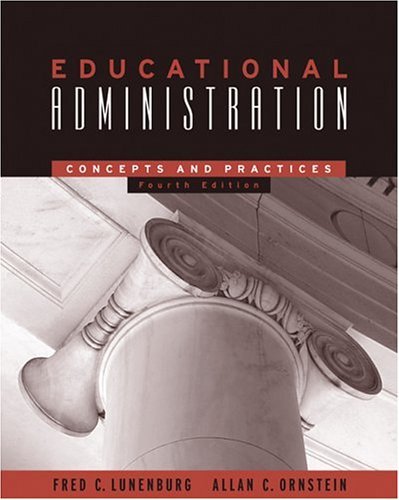
Lunenburg, F. C., & Ornstein, A. C. (2004). Educational Administration: Concepts and Practices.(4th ed.) Belmont, CA: Wadsworth Publishing Company

top of page


IV. ORGNIZATIONAL STRUCTURE AS RELATED TO MISSION, KNOWLEDGE BASE, AND STANDARDS

top of page


V. COURSE REQUIREMENTS

EDAL 520 FA05

Power point Case Study (student to student)Evaluation Form

Presenter's name_____________________

Evaluator's name_____________________

Case Title______________________________________________________________

Instructions: Star (X) your response in the “Weak” “Average” or “Strong” box and email your response to ggifford@andrews.edu

 
WEAK
AVERAGE
STRONG

Description of the case:


Identification of all the problems/issues:


Identification of the 2 problems to solve:


Quality of the solutions presented:


Strength and calarity of the powerpoint presentation:


Overall effectiveness of the presentation:


Additional comments:______________________________________________________________

_______________________________________________________________________

top of page


VI. COURSE OUTLINE

(Schedule and Notes)

Session/Date Topics Chapter Outlines and Notes
Lunenberg & Ornstein
Assignments
  First Class Introductory Outline for Face to Face and Online Students    
AUG 31 Development of Administrative Theory Chapter 1  
SEP 7 Organizational Structure Chapter 2 Quiz 1
SEP 14 Organizational Culture Chapter 3 Quiz 2
SEP 21 Motivation Chapter 4 Quiz 3
SEP 28 Leadership - ONLINE CLASS Chapter 5
Lesson Plan for SEP 28 Online Class
Quiz 4
OCT 5 Decision Making Chapter 6

Critique Due

Quiz 5

OCT 12 Communication Chapter 7 Quiz 6
OCT 19 Organizational Change Chapter 8 Quiz 7
OCT 26 The Federal and State Government and Education Chapter 9 Quiz 8
NOV 2 Local School Districts - ONLINE CLASS Chapter 10
Lesson Plan for Nov 2 Class
Quiz 9
NOV 9 School Finance and Productivity (Part 1) Chapter 11

Critique Due

Quiz 10

  School Finance and Productivity (Part 2)  
NOV 16 Legal Considerations and Education (Part 1) Chapter 12 Quiz 11
  Legal Considerations and Education (Part 2)  
NOV 30 Human Resource Management (Part 1) - ONLINE CLASS Chapter 15
Lesson Plan for NOV 30 Online Class
Quiz 12
  Human Resource Management - (Part 2) Power Point Case Studies Due
DEC 7

Analyzing and Improving Teaching - Final Class

Chapter 14; Chapter 16  
DEC 14 Final Exam Happy Fall Break!  


top of page


VII. EVALUATION

A. The following table outlines the standards used for evaluating the papers expected in Activity #2

A B C D
Tightly focused writing relating to a narrow topic. Generally focused on single topic. Somewhat focused on broad topic. Scattered random writing without focus.
A high degree of conceptual development Indicates good ability to conceptualize Concept discussed but not well developed. Little if any conceptualization.
Properly documented where sources used. Outside sources given proper credit. Outside sources alluded to. No credit given to sources used.
Excellent organization and logical progression of thought. Good organization and logic. Moderately well organized, but logical progression not evident. Poorly organized with little or no logic evident.

Excellent use of prose in capturing the essence of referenced material. A good job of summarizing the material reviewed. Much paraphrasing of other material. Mostly paraphrased or copied; not really the authors own work.
Syntax and grammar excellently done. Well edited material. Only a few errors of minor significance. A number of errors. Not well edited. Many errors. Poor grammar and sentence structure.
Complete yet concise discussion of the issue. Concise and generally recognizes most aspects of the topic. Topic appears to be one-sided with aspects of the topic missing. Overly verbose. Incomplete discussion of the issue. Major points ignored.
Opinion based on fact, research or scholarly authority. Generally good evidence given in support of opinion. Evidence only somewhat supports opinion. Opinion entirely unsupported.

B. Final Grades are based on the following distribution of points with the calculation of the grades as illustrated below:

  Percent of Grade Max Possible Pts. Your Score Weighted Percent
Activity # 1- Attendance/Particip 15% 30  9 4.5%
Activity # 2-
Article Critique 1
5% 20  18  4.5%
Article Critique 2 5% 20 18 4.5%
Activity #3-
Case Study/PPP
20% 40  40 20.0%
Activity # 4-
Quizzes
25% 50  50  25%
Activity #5-
Final Take Home Exam
30% 60  57  28.50%
Total 100% 200  284  87.00%
Suggested Grade Scale: A (95-100), A- (90-94.9), B+ (85-89.9), B (80-84.9), B- (75-79.9), C+ (70-74.9), C (65-69.9)
top of page

VIII. TIPS FOR DOING RESEARCH ON THE WEB


top of page


IX. ACADEMIC DISHONESTY POLICY

Andrews University, as a Seventh-day Adventist insitution, expects students to dmonstrate the ability to think clearly and exhibit personal moral integrity in every sphere of life. Honesty in all academic matters is a vital component of personal integrity. Breaches in academic integrity principles are taken seriously by the University. Acts of academic dishonesty as described in the University Bulletin are subject to incremental disciplinary penalties with redemptive intent. Such acts are tracked in the office of the Vice President for Academic Administration. Repeated and/or serious offenses will be referred to the Committee on Academic Integrity for Further recommendations on penalties.To Avoid involement in academic dishonesty, in this course my policy will be:Cheating (using notes or the responses of someone else) on quizzes will reduce the point value of the quiz to zero.Plagiarism (using material from someone else without giving appropriate credit) on preentations, critiques etc. will reduce the point value of that activity to zero.


top of page


X. AFFIRMATION ACTION STATEMENT

The School of Education, and the University are committed to providing appropriate support for students with documented disabilities, including learning disabilities. Any student who has a documented disability may identify him/herself to the teacher at the beginning of the semester so that reasonable accommodations or arrangements can be made.
top of page

XI. REFERENCES

BIBLIOGRAPHY OF BOOKS AND ARTICLES

Books and Monographs

Allen, D. W. (1992). Schools for a new century: A conservative approach to radical school reform. Westport, CT: Praeger.

Allington, R. L. (1996). Schools that work: Where all children read and write. New York: Harper Collins College Publishers.

Anderson, D. R. (1982). An introduction to management science: Quantitative approaches to decision making.St. Paul, MN: West.

Arcaro, J. (1995). Creating quality in the classroom. Delray Beach, Fl: St. Lucie Press,

Arnold, J. D. (1992). The complete problem solver: A total system for competitive decision making. New York: Wiley.

Bennis, W. (1989). Why leaders can't lead. The unconscious conspiracy continues. San Francisco, CA: Jossey-Bass Publishers.

Berguist, W. A. (1986). Planning effectively for educational quality. San Francisco, CA: Jossey-Bass.

Berquist, W. (1993). The postmodern organization. San Francisco, CA: Jossey-Bass.

Black, J., & English, F. (1986). What they don't tell you in schools of education about administration. Lancaster, PA: Technomic.

Blase, J., & Blase, J. R. (1994). Empowering teachers: What successful principals do. California: Corwin Press.

Caldwell, B. ( 1987). Leading the self-managing school. Washington, D.C.: Falmer.

Campbell, R. F. (1987). A history of thought and practice in educational administration. New York: Teachers College Press.

Dalin, P. (1993). Changing the school culture. New York: Cassel IMTEC Foundation.

Dubrin, A. J. (1995). Leadership: research findings, practice, and skills. Princeton, NJ: Houghton Mifflin Company.

Dufour, R. P. (1991). The principal as staff developer. Bloomington, IN: National Educational Service.

Drucker, P. F. (1939). The end of economic man. New York: The John Day Company

. . (1972). Concept of the corporation. New York: The John Day Company

. . (1985). The effective executive. New York: Harper and Row

. . (1942). The future of industrial man, a conservative approach. New York: The John Day Company

. . (1985). Management: tasks, responsibilities, practices.(1st ed.). New York: Harper and Row.

Duke, D. L. (1991) School policy. New York: McGraw-Hill.

Dunlap, D. M., & Schmuck, P. A. (Eds). (1995). Women leading in education. Albany, N.Y: State University of New York Press.

Dunn, K. J., & Dunn, R. S. (Eds.). (1983). Situational leadership for principals: The school administrator in action. Englewood Cliffs, NJ: Prentice-Hall.

Fielder, F. E. (1984). Improving leadership effectiveness: The leader match concept : New York: Wiley.

Finn, C. E. (1991). We must take charge. Our schools and our future. New York Free Press.

First, P. F. (1992). Educational policies for school administrators. Boston: Allyn and Bacon.

Gainey, D. D. (1993). Education for the new century: Views from the principal's office. Reston, VA: National Association of Secondary School Principals.

Genen, H., & Moscow, A. (1984). Managing. New York: Doubleday and Company.

Goldring, E. B., & Rallis, S. F. (1993) Principals of dynamic schools: Taking charge of change. California: Corwin Press.

Gorton, R. A. (1987). School leadership and administration: Important concepts, case studies and simulations. Dubuqe, IA:

W. C. Brown. Guthrie, J., & Reed, R. (1986). Educational administration and policy. Englewood Cliffs, NJ: Prentice-Hall.

Hanson, E. (1985). Educational administration and organizational behavior (2nd ed.). Boston, MA: Allyn and Bacon.

Halpin, A. W. (ed). (1985). Administrative theory in education. New York: The Macmillan Company.

Haller, E. J. & Strike, K. A. (1988). The ethics of school administration. New York: Teachers College Press.

Hallinger, P. (ed). (May 1992) "School leadership development: Evaluating a decade of reform". Education and Urban Society, (24)3: Corwin Press Inc.

Heller, R. (1984). The super manager: Managing for success, the movers and the doers, the reason why. New York: Truman Talley Books. E.P. Dutton Inc.

Herzberg, F. (1976). The managerial choice: To be efficient and to be human. Homewood, IL: Dow Jones-Irwin.

Hill, M. S., & Ragland, J. C. (1995). Women as educational leaders. California: Corwin Press.

Hoy, W. K. and Tarter, C. J. (1995). Administrators solving the problems of practice. Boston, MA: Allyn and Bacon

Hoy, W. K., & Miskel, C. G. (1996). Educational administration: Theory, research and practice (5th Ed.). New York: McGraw-Hill, Inc.

Jacobson, S L., & Berne, R. (Eds.). (1993). Reforming education: The emerging systemic approach. Thousand Oaks, CA: Corwin Press.

Jones, J. J. (1994). Human resource management in education. Lancaster, PA: Technomic Pub. Company.

Joyce, B. R. (1986) Improving america's schools. New York: Longmans.

Kaufman, R. A. (1991) Strategic planning in education. Rethinking, restructuring, revitalizing. Lancaster: Technomic Publishers.

Kets de Vries, M. F. R. (1993). Leaders, fools and impostors. San Francisco: Jossey Bass Publishers.

Kets, de Vries, M. F. R., and Associates. (1991). Organization on the couch. Clinical perspectives on organizational behavior and change. San Francisco: Jossey-Bass Publishers.

Kirchmann, R. E. (1996). Educational administration: A collection of case studies. New Jersey: Merrill.

Kouzes, J. M. & Posner, B. Z. (1993). Credibility: How leaders gain and lose it, why people demand it. San Francisco, CA: Jossey-Bass Publishers.

Kowalski, T. J. (1996). Public relations in educational organizations: Practice in an age of information and reform. Englewood Cliffs, NJ: Merrill.

Levine, M. (1988). Effective problem solving. Englewood Cliffs, NJ: Prentice-Hall.

McCormacK, M. H. (1989). What they don't teach you at Harvard Business School. Notes from a street-smart executive. New York: Bantam Books.

Millard, R. M.(1991) Today,s myths and tomorrow's realities. Overcoming obstacles academic leadership in the 21st. century. San Francisco: Jossey-Bass Publishers.

Naisbitt, J., & Aburdene, P. (1985). Re-inventing the corporation: transforming your job and your company for the new information society. New York: Warner Books.

Morris, W. C., & Sashkin, M. (1976). Organization behavior in action: Skill building experiences, St. Paul, MN: West.

Ouchi, W. (1981). Theory Z: How american business can meet the japanese challenge. Reading, Massachusetts: Addison-Wesley Publishing Company.

Owens, R. G. (1995). Organizational behavior in education. (5th ed.) Boston,Ma: Allyn and Bacon.

Pennings, J. M. (1983). Decision making: An organizational behavior approach. New York: M.Weiner.

Peters, T., & Waterman, R. H. (Jr). (1982). In search of excellence. New York: Harper & Row Publishers.

Peters, T. (1992). Liberation management. New York: Alfred A. Knopf.

Peters, T. (1987). Thriving on chaos. New York: Alfred A Knopf.

Peters, T., & Austin, N. (1985). A passion for excellence: the leadership difference. New York: Random House.

Plunkett, L. C. (1982). The proactive manager: The complete book of problem solving and decision making. New York: Wiley.

Ribbins, P., Glatter, R., Simkins, T., & Watson, L. (Eds.). (1991). Developing educational leaders. Harlow, England: Longman.

Richardson, M. D., Lane, K. E., & Flanigan, J. L. (Eds.) (1995). School Empowerment. Lancaster, PA: Technomic Publication.

Schein, E. H. (1985). Organizational culture and leadership. San Francisco: Jossey-Bass Publishers.

Smith, S. C. (1990). The collaborative school: a work environment for effective instruction. Eugene, OR: ERIC Clearinghouse on Educational Management

Stone, S. C. (1987). Strategic planning for independent schools. Boston National Association of Independent Schools.

Starratt, R. J. (1995). Leaders with vision. California: Corwin Press.

Toffler, A. (1990). Power shift: Knowledge, wealth, and violence at the edge of the 21st century. New York:Bantam Books.

Towsend, R. (1984). Further up the organization. How to stop management from stifling people and strangling productivity. New York: Alfred A. Knopf.

Vaill, P. B. (1989). Managing as a performing art. New ideas for a world of chaotic change. San Francisco: Jossey-Bass.

Vroom, V. H. (1988). The new leadership: Managing participation in organizations. Englewood Cliffs, NJ: Prentice Hall.

Wallace, C. W. (Jr). (1995). From vision to practice. California: Corwin Press.

Walton, J. (1959). Administration and policy making in education. Baltimore: The John Hopkins Press.

Willower, D. J. (1994). Educational Administration: inquiry,values practice. Lancaster,PA: Technomic Pub. Co. INC.,

White, E. G. (1903). Education. Mountain View, CA: Pacific Press Publishing Association.

White, E. G. (1923). Fundamentals of Christian education. Nashville, TN: Southern Publishing Association.

Woodard, H. (1994). Navigating through change. Burr Ridge, IL: Irwin Professional Publishing.

Yukl, G. (1989). Leadership in organizations (2nd ed.). Englewood Cliffs, NJ: Prentice Hall.

Articles

David, J. L. (1996). The who, what, and why of site-based management. Educational Leadership, 53(4), 4-9.

Dubin, A. E. (1987). Administrative training: Socializing our school leaders. Planning and Change. 18(1), 33-37.

Elam, S. M., & Rose, L. C. (1995). The Phi Delta Kappa/Gallup Poll of the public's attitudes toward public schools. Phi Delta Kappan, 77(1), 41-56.

Freeston, K. R. (1992). Getting started with TQM. Educational Leadership, 50(3), 10-13.

Martin, J. R. (1995). A philosophy of education for the year 2000. Phi Delta Kappan, 76, 355- 359.

Odden, E. R., & Wohlstetter, P. (1995). Making school-based management work. Educational Leadership, 52(5), 32-36.

O'Neil, J. (1995). On technology schools: A conversation with Chris Dede. Educational Leadership, 53(2), 6-11.

Sergiovanni, T. J. (1995). Small schools, great expectations. Educational Leadership, 53(3), 48-52.

Smith, F. (1995). Let's declare education a disaster area and get on with our lives. Phi Delta Kappan, 76(8), 584-590.

Squires, D. A., & Kranyik, R. D. (1996). The Comer Program: Changing school culture. Educational Leadership, 53(4), 29-32.

Stallings, J. A. (1995). Ensuring teaching and learning in the 21st century. Educational Researcher, 24, 4-8.

Sternberg, R. J., & Horvath, J. A. (1995). A prototype view of expert teaching. Educational Researcher, 24, 9-17.

Reitzug, U. C., & Burello, L. C. (1995). How principals can build self-renewing schools. Educational Leadership, 52(7), 48-50.


top of page


WWW Links for EDAL520

top of page


Professional Journals on Leadership and Administration
Administrative Science Quarterly
American Behavioral Scientist
American Education
American Educational Research Journal
American Journal of Sociology
Behavioral Science
Change
Clearing House
Comparative Education
Contemporary Education
Education
Education and Urban Society
Educational Administration Quarterly
Educational Administrator's Abstracts
Educational Digest
Educational Forum
Educational Leadership
Educational Planning
Educational Record
Educational Researcher
Educational Research Quarterly
Educational Technology
Elementary School Journal
Exceptional Children
High School Journal
Human Organization
Human Relations
Interchange
International Social Science Journal
Journal of Applied Behavioral Science
Journal of Conflict Resolutions
Journal of Education
Journal of Educational Administration
Journal of Educational Psychology
Journal of Educational Research
Journal of Educational Sociology
Journal of Educational Thought
Journal of Experimental Education
Journal of Experimental Thought
Journal of General Education
Journal of Higher Education
Journal of Human Resources
Journal of Learning Disabilities
Journal of Negro Education
Journal of Social Issues
Journal of Special Education
Journal of Teacher Education
Management of Personnel Quarterly
Management Science
NAASP Bulletin
Personnel
Personnel Administration
Personnel Administrator
Personnel Psychology
Phi Delta Kappan
Planning and Change
Policy Sciences
Public Administration Review
School Management
Sociology of Education
Teachers College Board
Today's Education
Urban Education

top of page