Desmond Murray’s Research Activity
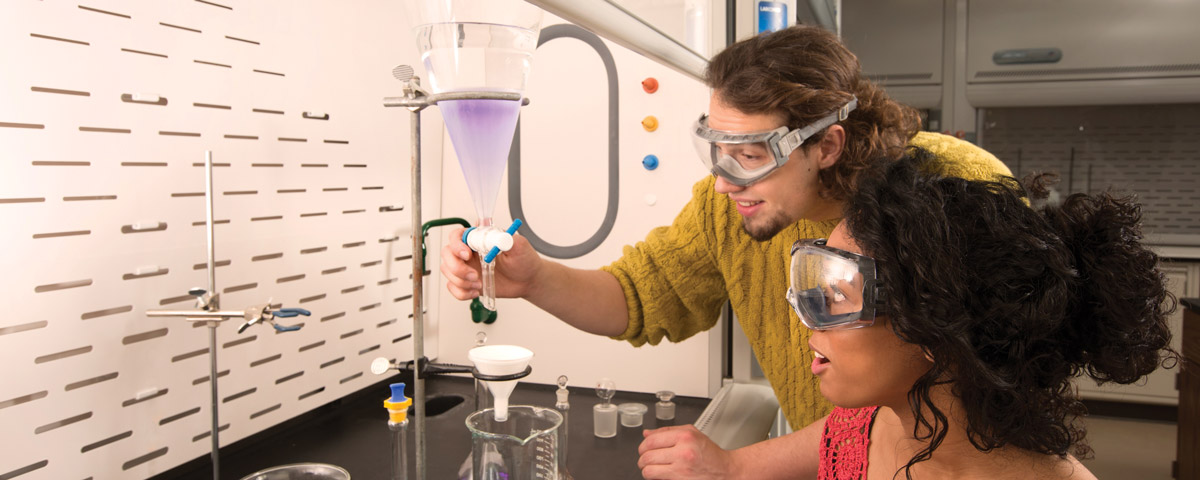
Nine students are working in the Building Excellence in Science and Technology (BEST) summer research program designed and supervised by Desmond. This program which provides early research experiences for area high school and college students is supported by his NSF grant. Three of the students just recently completed the twelfth grade year from the Berrien County Mathematics and Science Center and six of the students are college students - one from the University of Michigan and five from Andrews.
A variety of innovative synthetic organic chemistry projects and computational/molecular modeling work are being done. One of these projects involves making a wide variety of chalcone stilbenes or chalbenes and studying their spectroscopic properties. The precursor chalcones and stilbenes are plant natural products whereas chalbenes are not naturally occurring and have not been synthesized or characterized. The chalbene molecules are highly conjugated and are expected to possess interesting and perhaps unique electrooptical properties.
Other projects that progress is being made on includes (a) making new types of multicationic dyes belonging to the Malachite Green family, (b) synthesizing seven membered ring molecules via novel oxidative methods, (c) studying the interaction of azachalcones with toxic organophosphates and (d) preparing new antibacterials and antiparasitics from novel chalcone structures. Every day, BEST students are diligently making new molecules and determining their structures using NMR, IR and UV-Vis spectroscopy.
Nine students are working in the Building Excellence in Science and Technology (BEST) summer research program designed and supervised by Desmond. This program which provides early research experiences for area high school and college students is supported by his NSF grant. Three of the students just recently completed the twelfth grade year from the Berrien County Mathematics and Science Center and six of the students are college students - one from the University of Michigan and five from Andrews.
A variety of innovative synthetic organic chemistry projects and computational/molecular modeling work are being done. One of these projects involves making a wide variety of chalcone stilbenes or chalbenes and studying their spectroscopic properties. The precursor chalcones and stilbenes are plant natural products whereas chalbenes are not naturally occurring and have not been synthesized or characterized. The chalbene molecules are highly conjugated and are expected to possess interesting and perhaps unique electrooptical properties.
Other projects that progress is being made on includes (a) making new types of multicationic dyes belonging to the Malachite Green family, (b) synthesizing seven membered ring molecules via novel oxidative methods, (c) studying the interaction of azachalcones with toxic organophosphates and (d) preparing new antibacterials and antiparasitics from novel chalcone structures. Every day, BEST students are diligently making new molecules and determining their structures using NMR, IR and UV-Vis spectroscopy.
Grace Carlos, Administrative Assistant, is in Jordan
This summer Grace was invited to join the archeology team headed by Dr. Oystein LaBianca that is working at tel Hesban in Jordan. The team consists of about 40 staff and students from Andrews, Calvin College, and Grand Valley State University, plus about 30 young men from the local area to assist with the digging, sifting, and transporting the artifacts. Grace is the artifact recorder and will be with the dig from June 11 until July 9. She has been experiencing the thrill of travel including a new place, new foods, eating her first breakfast at 5 a.m. and her second breakfast at 9 a.m., traveling to Mr. Nebo and going to Petra after watching Indiana Jones and the Last Crusade. She will undoubtedly come back with many interesting stories; stop by the office next school year!
Computer Cluster Donated by the Wilson Family
Last summer Robert Wilson, 2007 Chemistry graduate and soon-to-be graduate student at the University of Illinois at Urbana-Champaign, participated in a computational chemistry internship/COOP experience at the University of Iowa. After returning to Andrews, he got the idea that the department needed a computer cluster and the capability to engage in the type of computational chemistry he’d participated in at Iowa and he persuaded his parents, Don and Elizabeth Wilson, to purchase the components for a three computer cluster that he and James Hood designed and built. The computers have 12x3 GHz processors, 16 Gb of ram, 1.24 Tb (yes, that’s terabits!) of hard drive space plus a number of other important components. The operating system is Linux Debian and currently the cluster has GAMESS (General Atomic and Molecular Electronic Structure System) loaded and operating. Future plans call for adding Spartan 06 and Chem Office Ultra 10.0 to increase the system’s capabilities. This is a much appreciated and highly capable addition to the teaching and research equipment and instruments of the department.


